
The asphalt you see is the last thing we build.
Asphalt paving for driveways, parking lots, drive aisles, and private roads across Seattle and King, Snohomish, and Pierce counties. Before the paver arrives we’ve shaped the grade, built the base, and given the rain somewhere to go, because the buried work is what decides how long a surface lasts. Estimates are free, and the line answers every day.
Open every day, 6 AM to 6 PMKing, Snohomish & Pierce
When is new asphalt the right call?
New asphalt is the right call in two situations: there’s nothing paved yet, or what’s there is failing from the base underneath, where repairs won’t hold. If the wear is only at the surface, resurfacing is the cheaper fix, and we’ll say so at the estimate. Here’s what we look for on a Seattle-area walk.
Applies to
- Driveways
- Parking lots
- Drive aisles
- Private roads
Gravel that ruts and turns to mud every winter
Pavement broken up past the point of patching
A new home, shop, or lot with no surface on it yet
Failures coming from the base, where repairs won’t hold
How does a new asphalt surface get built?
Paving lasts or fails on what you can’t see from the curb. Every job walks the same sequence, sized to the ground it’s on.
Grade and drainage
The subgrade is cut, shaped, and pitched so water leaves the surface instead of living under it. In this climate, drainage is the whole game.
The base
Aggregate base goes down and is compacted until it drains and carries load. A weak base telegraphs through the best mat ever laid.
Hot mix, laid hot
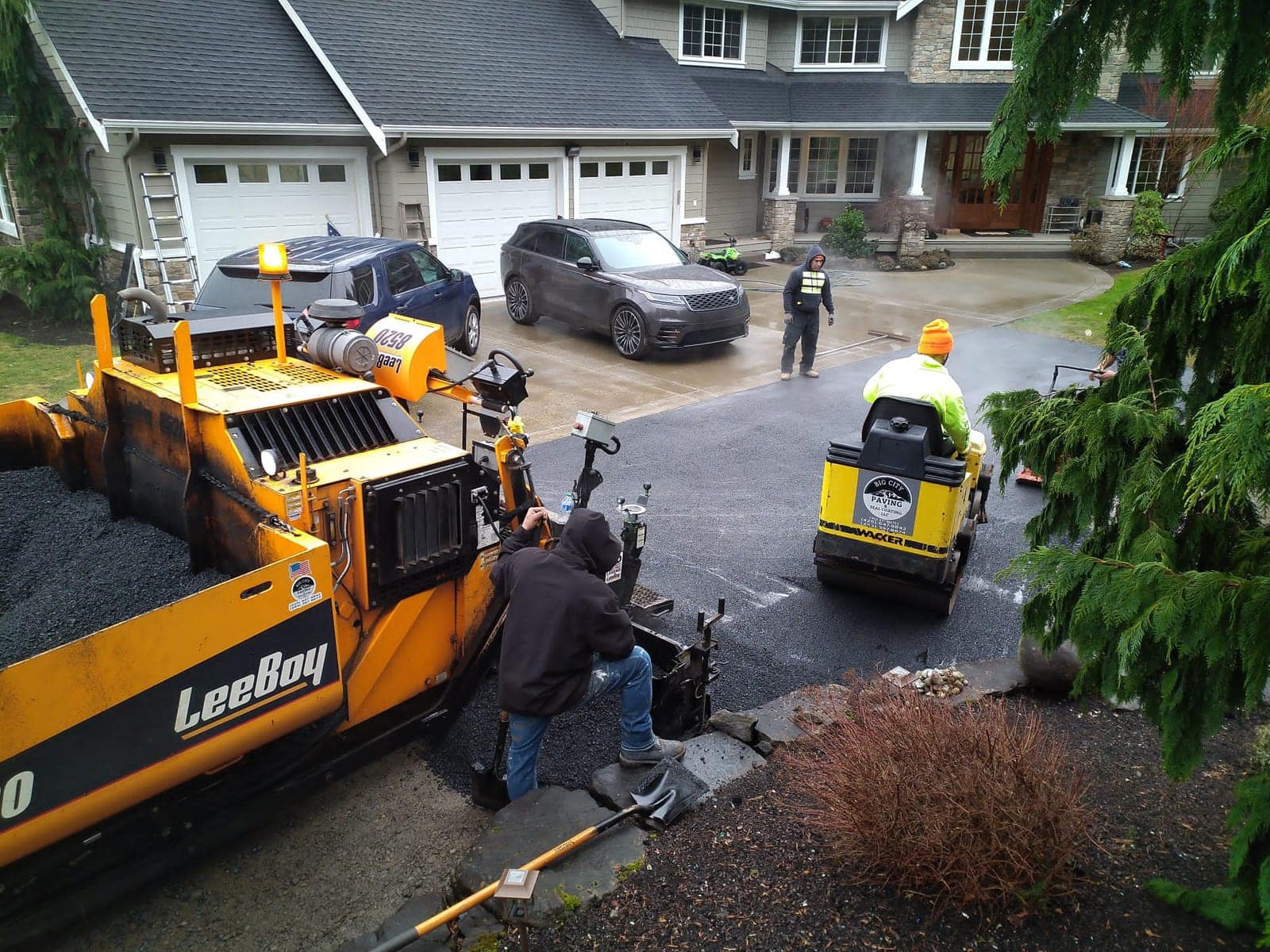
Hot-mix asphalt runs through the paver at temperature and gets rolled before it cools. Timing the Puget Sound forecast is part of the trade.
Rolled to grade
Steel-drum rollers compact the mat to a tight, even finish, pitched to the drainage plan, and the edges get compacted too, because that’s the first place a cheap job fails.
What does asphalt paving cost in the Seattle area?
Every paving quote is priced from the ground, not a rate card, so the honest answer is a walked estimate, and ours are free. What moves the number is mostly what happens under the mat: how much grading and drainage correction the ground needs, how much base has to be built, the area and thickness of asphalt, and how hard the site is to reach and stage.
Call (253) 397-8674- Groundwork
- Grading, drainage correction, and base construction are usually the largest share of a paving job. Ground that already drains and carries load prices lower than ground that needs building.
- Area and thickness
- The square footage and the thickness the use calls for set the material quantity. A driveway and a loaded truck lane are not the same mat.
- Access and staging
- Tight sites, steep grades, and long material runs add machine and crew time that an open, level site does not.
- Removal and disposal
- Paving over prepared ground costs less than cutting out and hauling off a failed surface first.
When can asphalt be paved in Western Washington?
Hot-mix asphalt needs dry ground and mild temperatures, so the paving season here runs roughly late spring through early fall, scheduled around the forecast. Most residential jobs take a day or two on site once the ground is ready. Larger lots run longer and can be phased. Treat any timeline as guidance until we’ve walked the site, and plan for a few days of cure before parking on the new mat.
Twenty-plus years of base-first habits.
We’ve spent more than twenty years in the trade around King, Snohomish, and Pierce counties, and the marker counts above are real jobs, not marketing. We lay nothing we wouldn’t put at our own place, we answer the phone every day from 6 AM to 6 PM, and the photograph on this page is our own crew on a real driveway.
The proof is in the photographs.
Our own crews on our own jobs around Puget Sound, every frame captioned as exactly what the camera saw. Not a stock photo among them.
See the asphalt projectsAsphalt paving, answered.
The questions we answer on the phone all day, written down. If yours isn’t here, call. The line’s open every day, 6 AM to 6 PM.
- How does Seattle’s rainy climate affect new asphalt?
- Rain is the main enemy of pavement in the Puget Sound area: water that works its way under the surface softens the base and leads to cracks and potholes. That’s why we build with proper grading and drainage, compact a solid aggregate base, and lay quality hot-mix asphalt that sheds Pacific Northwest rain. Installed right, asphalt stands up to our wet winters extremely well.
- Should I choose asphalt or concrete for my driveway or lot?
- Asphalt is generally more affordable to install, flexes with our freeze-thaw swings instead of cracking the way rigid slabs can, and it’s far easier to repair: patches, resurfacing and sealcoating blend right in. Concrete costs more up front and repairs rarely match the original surface. For most Seattle-area driveways and parking lots, asphalt is the practical choice.
- When is the best time of year to pave in Western Washington?
- Hot-mix asphalt needs dry ground and mild temperatures to compact properly, so the dry stretch from late spring through early fall is ideal. We watch the forecast and schedule paving for dry windows. Call us early and we’ll help you time your project.
- What determines the cost of a new driveway or parking lot?
- The ground more than the asphalt: grading and drainage work, how much base must be built, the area and thickness being paved, and how easy the site is to reach. That’s why we quote from a free on-site walk instead of a per-foot rate. The number you get is for your ground, not an average.
- How do I get an asphalt paving estimate?
- Call us at (253) 397-8674 for a free consultation, or send the contact form and we’ll get back to you. We pave for homes and businesses across King, Snohomish and Pierce counties, every day from 6 AM to 6 PM.
The work that rides along.
Most jobs pair one service with another: a repair wants a sealcoat after, a fresh overlay wants its lines back. These are the exits we take most often from this page.
Asphalt Resurfacing
A fresh wearing course over a base that still holds: a like-new surface, well short of rebuild cost.
Asphalt Sealing
A sealcoat that keeps water and sun out of sound pavement: the cheapest years a surface can buy.
Asphalt Maintenance
Inspection, crack sealing, patching, and seal-coat cycles: the quiet work that keeps small problems small.
Talk to the crew.
Tell us where the surface is and what it’s doing, and we’ll tell you what it needs. Estimates are free, and the line’s open every day, 6 AM to 6 PM.